Skilled Clinician
Overview
The Skilled Clinician course is a longitudinal clinical skills curriculum that begins in the first year and continues through the pre-clerkship phase, providing a foundation for clerkships and advanced clinical experiences. Students move from foundational communication, history taking, physical examination, and documentation toward more integrated clinical reasoning, recognition of abnormal findings, assessment and plan development, and preparation for increasingly complex patient care.
Through simulation, clinical experiences, and guided practice, students build the skills and confidence needed to care for patients with increasing independence, bridging foundational science, patient communication, clinical decision-making, and readiness for clerkships.
Students Progressively Develop Skills In:
- Patient-centered communication
- History taking and physical examination
- Clinical reasoning and differential diagnosis
- Recognizing normal and abnormal findings
- Documentation and clinical presentation skills
- Assessment and plan development
- Shared decision-making and other advanced communication skills
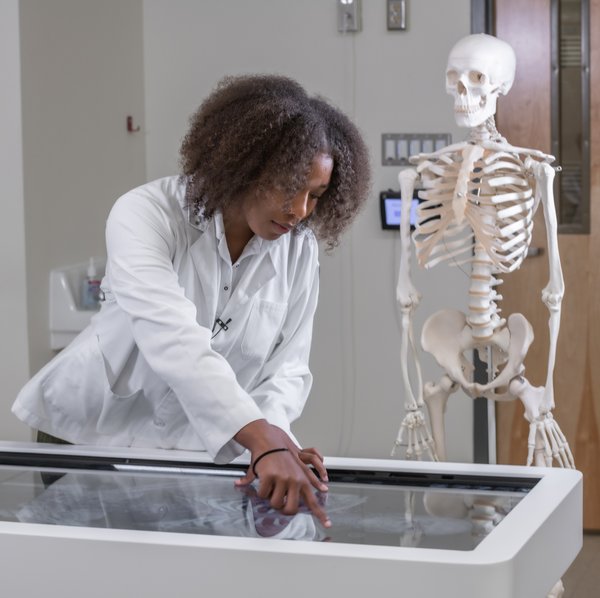
Point-of-Care Ultrasound (POCUS) Progression
Year 1
The science of ultrasound, imaging modalities, and identification of normal anatomy
Year 2
Applying POCUS to recognize abnormal findings and support diagnosis of disease states.
Art & Profession
Overview
A longitudinal course spanning all four years that supports students’ development into thoughtful, compassionate, and effective physicians. Through four interconnected themes, students connect professional identity formation, lifelong learning, community partnership, inquiry, leadership, and residency preparation with the care of patients and communities.
The Good Clinician
The foundation of physician development at Xavier Ochsner College of Medicine
Students explore professional identity formation, ethics, humanities, health systems science, law and reflective practice to become physicians who lead with integrity, compassion, and accountability.
The Effective Pupil
Medicine requires continuous growth and adaptation
Students develop strategies for lifelong learning, resilience, self-reflection, goal setting, and wellness that support success in medical school, residency, and professional practice.
The Community Advocate
Health is shaped by more than biology alone
Students learn alongside community partners to understand and address social drivers of health and advocate for patients, populations, and communities.QUEST
Curiosity, inquiry, scholarship, and innovation
Students learn to formulate meaningful questions, critically evaluate evidence, apply research to patient care, and contribute to the advancement of medicine and healthcare improvement.