Xavier Student Named University's First Udall Scholar
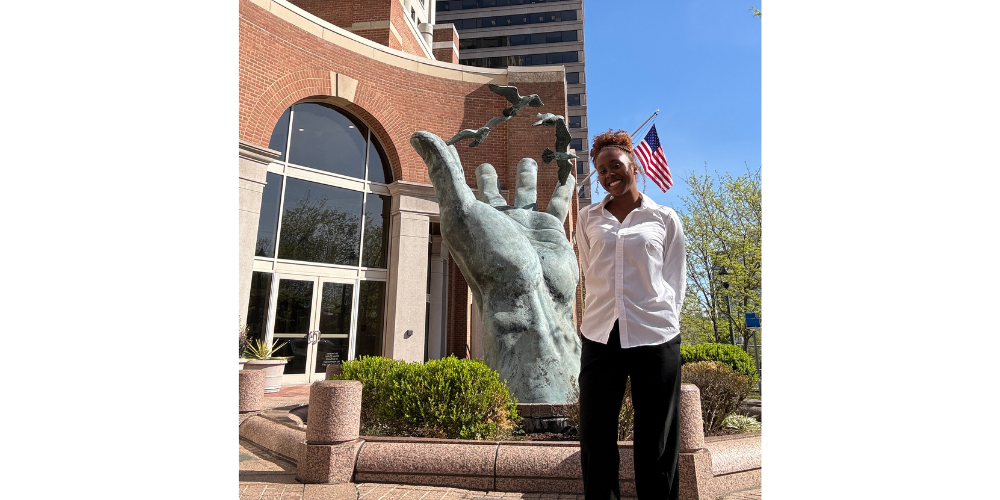
Xavier University of Louisiana student Sophia Speller has been named a 2026 Udall Scholar, becoming the University's first recipient of the prestigious national scholarship and the only student from an HBCU selected in this year's cohort.
A biology major with a chemistry minor from Chicago, Speller was selected from a national pool of 381 candidates representing 175 colleges and universities. The Udall Foundation named 55 Scholars and 55 Honorable Mentions for 2026, recognizing undergraduate students committed to careers in environmental stewardship, Tribal public policy, and Native health care. Xavier was among only three institutions nationwide to celebrate its first-ever Udall Scholar this year.
For Speller, the moment she learned of her selection was one of overwhelming joy.
"I was thrilled," she said. "I remember literally jumping for joy and doing a spin in my living room when I got the notification. I worked extremely hard with the help of my mentor and honors program director, Dr. Shearon Roberts. It was a lot of late nights, stress, and endless revisions. But in that moment, it was all worth it."
She added that being Xavier University's first Udall Scholar carries a special significance.
"I am immensely honored to be Xavier University's first recipient, and I know there will be many more after me who will share the joy and pride that this accomplishment brings," Speller said. "I am equally honored to shine a light on my school and the amazing students, faculty, and staff here who have helped me become who I am today."
As the only HBCU student selected in this year's class, Speller hopes her achievement highlights the excellence found across historically Black colleges and universities.
"There are assumptions or stereotypes surrounding students from HBCUs, especially those not attending your Spelmans or Howards," she said. "I hope my accomplishments communicate the drive, diligence, and ambition of Xavier students. I am incredibly proud to represent Xavier on the national level and showcase the intellectual rigor it offers."
She also hopes her selection encourages more HBCU students to pursue nationally competitive opportunities.
"I encourage more HBCU students to apply for these types of opportunities, and I hope more advisors and mentors push their students to throw their hats into opportunities like these," she said.
As a Rousseve Scholar and member of Xavier's Exponential Honors Program, Speller has distinguished herself through research, conservation efforts, and community engagement focused on environmental sustainability and ecosystem preservation.
"Sophia exemplifies the spirit of a Udall Scholar, following in the ideals of the former Congressmen Morris and Stewart Udall, committing her efforts toward environmental stewardship," said Dr. Shearon Roberts, associate dean of the Exponential Honors Program. "From her research in plant science to her conservation of native plant species in the Gulf South to her promotion of urban farming and sustainable agriculture, Sophia is on a mission to maintain the right balance of our ecosystems that human beings and animals depend on."
Speller's passion for environmental science began during high school internships at urban farms in Chicago.
"That is where I found my love for plants, community, and sustainable agriculture," she said.
She later worked at Chicago's Field Museum of Natural History, where she learned how climate change disproportionately affects low-income, Black, and Hispanic communities.
"I discovered ways to support those communities equitably, and this experience only deepened my desire to pursue a career in environmental science more broadly," she said.
At Xavier, Speller expanded her commitment to environmental stewardship through service and research. As a Future Coastal Leader with the Coalition to Restore Coastal Louisiana, she learned about the environmental challenges facing the state's coastal ecosystems and continues to volunteer through wetland restoration projects and urban reforestation initiatives with organizations including Soul NOLA.
Her laboratory experiences have further shaped her career goals. She conducted research in Dr. Huckaba's molecular biology laboratory and later participated in a Research Experiences for Undergraduates (REU) program at the Boyce Thompson Institute at Cornell University, where she supported research examining drought impacts on crop species. She conducts research in Dr. Ratnayaka's plant science laboratory.
"The value and knowledge I gained from these experiences ultimately led to my receiving this honor," Speller said.
Speller is also a 2025–2026 Hollings Scholar, a highly competitive scholarship program administered by the National Oceanic and Atmospheric Administration (NOAA) that supports students pursuing careers in environmental, oceanic, atmospheric, and related sciences.
This summer, she is interning with NOAA's Office of National Marine Sanctuaries, which oversees 18 national marine sanctuaries across the United States.
"Part of that protection is restoration," Speller said. "This summer, I am working to create a webpage for NOAA's Office of National Marine Sanctuaries showcasing the various restoration efforts across the sanctuary system."
The experience is helping her develop science communication skills that she believes are essential to her future career.
Looking ahead, Speller hopes to become a plant scientist working in sustainable agriculture, conducting research that addresses food security while helping communities adapt to and mitigate climate change.
"My goal is to become a plant scientist working in sustainable agriculture," she said. "I want my research to contribute to food security and to adapting to and mitigating climate change."
Following graduation, she plans to pursue graduate studies and potentially earn a doctoral degree. She says the Udall Scholarship will provide both financial support and invaluable professional opportunities.
The Udall Scholarship honors the legacies of Morris K. Udall and Stewart L. Udall, whose careers in public service helped shape environmental policy and conservation efforts in the United States. Scholars are selected based on leadership, public service, academic achievement, and a demonstrated commitment to addressing environmental challenges.