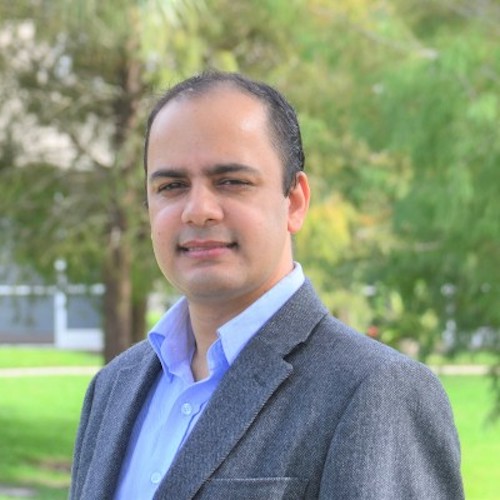
Udaya Raj Dahal
Xavier University of Louisiana
- Phone: (504) 520-5412
- Email: udahal@xula.edu
- Office: NCF Science Building - Room 237
About
Dr. Udaya R. Dahal is an assistant professor of physics whose academic path extends from the mountain landscapes of Nepal to the vibrant research communities of the United States. He earned his Ph.D. in Physics from the University of Connecticut, where he studied computer simulations of soft materials under the mentorship of Prof. Elena E. Dormidontova. He then completed postdoctoral research at Boston University with Prof. Qiang Cui. Before joining Xavier University of Louisiana, Dr. Dahal served as visiting faculty at Springfield College in Springfield, MA, followed by a visiting faculty appointment at Wesleyan University in Middletown, CT.
His research explores the interdisciplinary boundaries of theoretical and computational polymer physics, biophysics, environmental science, and sustainable energy materials. Using atomistic and coarse-grained molecular simulations, statistical mechanics, and emerging machine-learning tools, his group investigates structure–property relationships in complex nanoscale and soft-matter systems, with applications in materials design, drug delivery, cancer research, energy storage, and climate-relevant processes.
Research
My research program integrates theoretical polymer physics, computational polymer and soft-matter physics, biophysics, and environmental science. I use molecular modeling, large-scale simulations, and machine-learning approaches to understand how molecular architecture, interactions, and environment control the behavior and function of complex materials.
1. Polymer Physics & Soft-Matter Theory
Under the broad umbrella of polymer physics and soft-matter theory, I investigate how polymers and polymer-functionalized nanostructures organize, respond, and perform in solution and at interfaces.
- Polymers in solutions and concentrated environments
- Surface chemistry and nanoparticles, including soft and hard nanoparticle cores
- Polymer brushes and surface-grafted macromolecules
- Complex coacervation and associative phase separation
- Block copolymers, micelles, vesicles, and lipid nanoparticles
- Nanotubes and soft–hard hybrid nanostructures
- Polymer-grafted nanoparticles and interfacial phenomena
These systems serve as model platforms for applications spanning materials science to cancer research, with an emphasis on structure–property relationships and design principles for functional soft materials.
2. Biophysics, Nanomedicine & Drug Discovery
A central theme of my work is understanding how nanoscale objects interact with biological environments.
- Nanoparticle interactions with biomolecules and biological interfaces
- Polymer- and lipid-based drug-delivery systems
- Lipid nanoparticles, micelles, and vesicles for therapeutic applications
- Computational approaches in drug discovery and molecular recognition
- Cancer-relevant material behavior and nano–bio interactions
3. Computational Materials Science & Methods
My group employs a multiscale toolbox that combines atomistic detail with coarse-grained efficiency:
- Atomistic molecular dynamics using established force fields (e.g., OPLS-AA, CHARMM, AMBER)
- Coarse-grained and multiscale modeling for large, complex systems
- Enhanced sampling, free-energy calculations, and statistical analysis
- Atomistic and coarse-graining strategies for bridging scales
- Machine learning for materials prediction and structure–property inference
4. Sustainability, Renewable Energy & Environmental Science
I am also actively engaged in problems at the interface of materials science, sustainability, and the environment.
- Sustainable and recyclable polymers
- Polymer electrolytes and single-ion conducting systems for Li-ion and next-generation batteries
- Modeling and simulation of aerosols and air-quality dynamics
- Climate-science–related materials and environmental processes
- Machine learning for aerosols, climate, and environmental systems
Across these themes, my group seeks to connect microscopic mechanisms to macroscopic behavior, using theory, simulation, and data-driven tools to inform the design of new materials for energy, health, and the environment.
Teaching Philosophy
My teaching philosophy is rooted in inclusive excellence and the recognition that students at a Historically Black College or University (HBCU) bring diverse backgrounds, experiences, and levels of preparation to the classroom. I believe that every student can thrive in physics when given structured support, meaningful engagement, and opportunities to connect content with their own experiences and goals. I approach every classroom interaction with empathy, recognizing that understanding my students’ individual challenges and lived experiences is essential to supporting their success in physics.
I emphasize a student-centered, active-learning environment that incorporates culturally responsive instruction, collaborative problem-solving, and strong mathematical support. By integrating real-world applications, technology-enhanced visualization, and multiple forms of assessment and feedback, I aim to foster deep conceptual understanding, confidence, and a durable sense of ownership over the learning process.
Courses Taught
Undergraduate Courses
Introductory Physics
- Physics for Life Sciences I
- Physics for Life Sciences II
- Physics for Scientists and Engineers I
- Physics for Scientists and Engineers II
Upper-Division Physics
- Thermodynamics and Statistical Physics
- Non-Linear Dynamics and Chaos
Astronomy & General Education
- Introduction to Astronomy
- How Things Work
Graduate Courses
- Graduate Electrodynamics