Michael O. Ogunbunmi, PhD

Title: Assistant Professor
Department: Physics and Engineering, Xavier University of Louisiana
Ogunbunmi Research Group
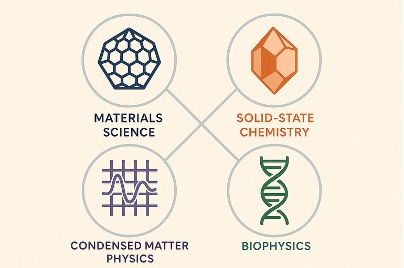
The lab investigates novel quantum and energy materials, particularly those of thermoelectrics, topological insulators, magnetocaloric effect, high entropy alloys, and magnetic materials. By studying these systems, we aim to discover tunable functionalities for next-generation energy conversion, solid-state cooling, spintronic technologies, etc. We are also interested in the studies that provide an understanding of material-tissue interactions and nanoscale systems for biomedical and life-science applications. A central component of our work is solid-state materials synthesis and structural characterization of bulk materials. Our lab is located in NCF 203, and it’s equipped with an arc melter, several muffle and tube furnaces, as well as a glass blowing workstation, for bulk materials synthesis both in the single crystal and polycrystalline forms. Additionally, our group is also exploring the synthesis of thin films using the Pulsed Electron Deposition (PLD) instrument, which is shared with another group and located in NCF 202. With the PLD, we are currently exploring the growth of oxides targeted for ferroelectric applications. Another shared facility housed in NCF 202 is the BioAssembyBot 400 instrument for exploring various aspects of material-tissue interactions.
The electronic, transport, and magnetic properties of the various materials are probed using various suites of in-house instruments and those in large-scale facilities to understand the interplay between structural, electronic, and magnetic degrees of freedom that may be of great interest and beneficial for various applications. In addition to our experimental works, we also leverage computational tools such as first principles calculations as implemented in ESPRESSO, VASP, and TBLMTO codes further unravel the electronic and transport properties of the various materials. In recent years, the group has further developed interests in the use of machine learning tools to study correlated electron behavior in condensed matter, and critical research capacity is being developed in such an area.
These research activities will provide a rich experience that is adequate for undergraduate and graduate students’ training in terms of safety, timeline, and learning impact. The multidisciplinary nature of the various projects will also provide the students with broader research perspectives and make them more competitive in their future endeavors. Students involved in these projects will learn broad techniques in solid-state synthesis of diverse materials with novel properties and applications, as well as their structural characterization based on powder and single-crystal X-ray diffraction data. Students would also have hands-on experience in investigating various aspects of structure-property relationships using several state-of-the-art techniques, and it would offer them first-hand experience in designing materials of interest and predicting their properties.